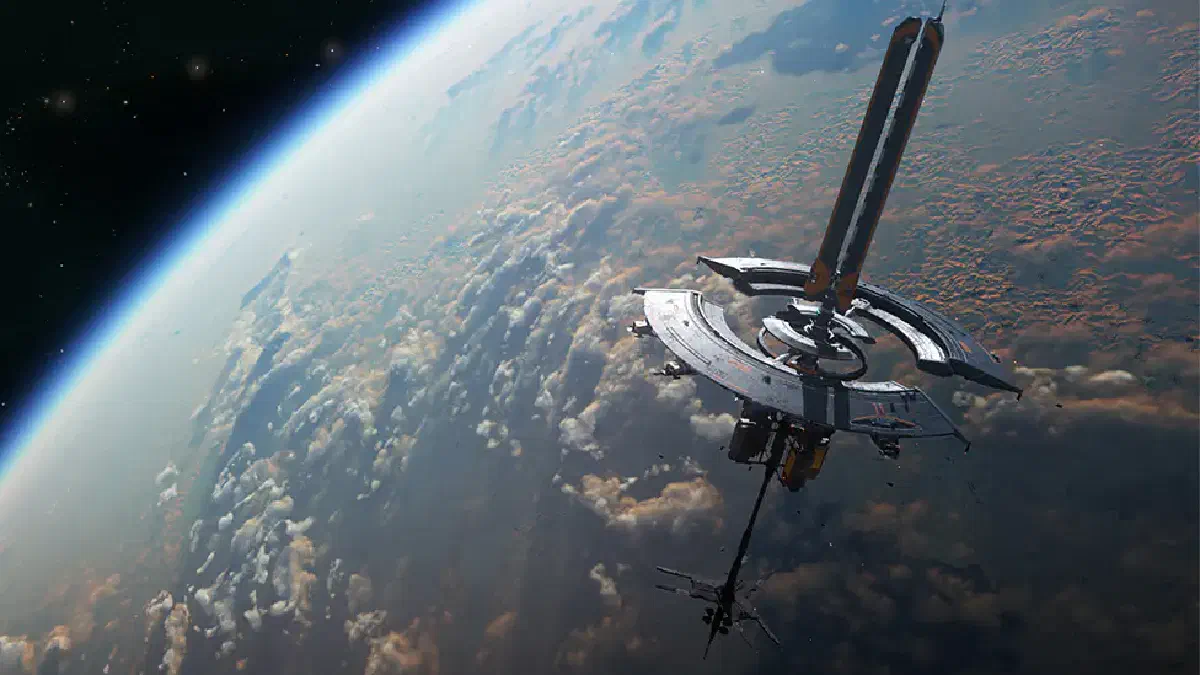
While Squadron 42, the single-player campaign, is waiting for its release, you can already play the online universe of Star Citizen today. Officially it’s still an alpha. That means: there are lots of bugs, but also loads to do. Roughly every two to three months, a big patch comes out with new content, ships and improvements. Here you get an overview of what to expect in the game right now and what tech is behind it.
As of: October 2026, Alpha 4.10.2. Star Citizen keeps evolving quickly, so individual details may change with the next patch.
What’s in the game right now
Star systems
You can currently travel to three star systems, connected to each other by jump points. Between planets, moons and stations you fly by quantum drive. Without any loading screens, of course.
Stanton
The Stanton system is the first and most developed system. Four planets, each owned by a megacorporation, plus lots of moons, space stations and outposts. Here the UEE keeps law and order, at least most of the time. In some corners, people don’t take the law quite so seriously. For newcomers, Stanton is the best starting point.
Pyro
Pyro is the second system and the exact opposite: no UEE, no rules. Whoever travels here solves problems with weapons, or with negotiating skills if the other side happens to be in a good mood. The sun is an unstable flare star, and the planets are scorched, poisoned or both. Dangerous, but that’s exactly why it’s rewarding.
Nyx
Nyx is the third system and still being built. There are no planets here yet, but there’s the legendary Levski, a station inside a hollowed-out asteroid and home of the rebel movement People’s Alliance. Nyx gets expanded with every patch, and the planets Nyx I to III are supposed to follow next.
Spaceships and vehicles
From nimble single-seaters to freighters and mining ships all the way to huge warships with dozens of crew stations: the selection is huge and grows with almost every patch. Which ships have already arrived in 2026 and which are still in the works is listed on the ships page. On the ground, there are buggies, motorcycles, tanks and transporters.
Engineering
In Star Citizen, ships aren’t health bars, they’re machines made of individual components. Shields, engines, power plants and coolers can fail. Components can catch fire, and that fire can spread on board.
You put out fires, repair or swap components and distribute power depending on the situation. On big ships, the crew can even do that in the middle of a fight while the pilot keeps flying. Since 2026, smaller ships can also be repaired, rearmed and refueled in the hangar of big ships, and fuel has become a real resource you have to keep an eye on.
Your flight suit plays a role too. With the right suit you can handle more G-forces before you black out.
Careers
How you earn your credits is up to you. Here are a few examples:
- As a hauler you carry goods between stations and planets.
- As a bounty hunter you hunt wanted criminals, in space or on foot.
- As a mercenary you take on combat contracts, all the way up to the Tactical Strike Groups: large-scale operations where you and your squad storm a fortified station in Nyx in several phases.
- As a miner you extract raw materials, with your ship, a ground vehicle or by hand with the Multi-Tool.
- As a salvage specialist you take wrecks apart and recycle what’s left.
- Plus: trading, refueling missions for other players, medical rescue, exploration and much more.
Technology
Star Citizen runs on the in-house StarEngine. It was originally based on CryEngine, but according to Chris Roberts hardly anything of that is left by now. Some of the systems underneath are pretty unique, and a few of the most exciting ones are only just about to break through.
A seamless universe
You get into your ship in your hangar, fly through the atmosphere into space, jump to a moon by quantum drive, land next to an outpost and walk inside. Not a single loading screen, no scene change. Planets rotate, day and night alternate, and almost every object physically exists: you can pick up the crate in your cargo hold, and the empty bottle you drop really is lying on the floor afterwards.
Server meshing
For such a big universe with lots of players to work, Star Citizen spreads the computing work across several servers. That’s called server meshing. All the servers of one game world (shard) share a common data state, so you fly from one server area into the next without noticing.
The upside of this setup: if your server ever crashes unexpectedly, you just wait a moment until a new server takes over its work. Then you carry on right where you left off.
Static server meshing has existed since the end of 2024 (Alpha 4.0). Each shard has a fixed number of servers, and each server is permanently responsible for certain areas, for example a planet with its moons. That raised the player count per shard to several hundred and improved performance. The catch: if lots of players gather in one place, the responsible server slows down, no matter how little is going on on the others.
Dynamic server meshing is supposed to solve this problem. Instead of fixed responsibilities, servers are added or shut down depending on load, and crowded areas are split across several servers. So the server follows the players, not the other way round. It isn’t quite finished yet, but the first building blocks are already running:
- Instancing: Since Alpha 4.10, groups can play certain missions in their own instance, which is spun up when needed and seamlessly connected to the universe. The first mission using it is the reworked Siege of Orison for up to four players.
- Quasi-dynamic meshing: Servers are already added or removed depending on load, but the areas themselves aren’t split yet.
You can read how things will continue in the outlook.
Crafting and the fabricator
Since Alpha 4.7 (March 2026), you can make items yourself. The centerpiece is the Item Fabricator, a big device you buy in selected shops. You can set it up in your hangar, store and retrieve it via the freight elevator, or put it on the cargo hold of suitable ships with a tractor beam and produce on the go. It can take things apart too: it turns bought, looted or self-made equipment back into raw materials.
The fabricator uses the materials you’ve put into it. If you set it up in your hangar, it also has access to your local inventory.
What you can build is determined by blueprints, digital construction plans with a list of materials. You have a few from the start, and you get most of them as rewards for missions. Right now these are FPS weapons, armor pieces and even ship components.
What’s exciting is the loop that crafting brings with it. Until now, you mainly mined raw materials to sell them. Now they become the starting material for something new. At the moment, crafting is fed exclusively by mining, with your ship, a ground vehicle or by hand. More sources like salvage or even farming are supposed to follow.
Raw material quality: Every raw material you mine has a quality value between 0 and 1000, and that’s exactly what decides the result. High-quality material produces an item with better stats than the standard model from the store, low-quality material one with worse stats. When crafting, you can see beforehand how your choice of materials affects the stats. If you mix different qualities, you get an average. That suddenly makes it interesting where you mine: the ore from that dangerous area might be exactly what makes your favorite rifle better.
Genesis
Genesis is a collection of new systems CIG uses to create planets and bring them to life. At its core is Planet Tech v5: biomes are no longer placed by hand, but result from physical factors like geology, erosion, soil moisture and distance from the sun. So swamps appear where there’s water, not where a designer painted them.
On top of that comes Starchitect, which procedurally assembles outposts and entire settlement clusters from modules and spreads them across the planets, and the Population Manager, which places the right inhabitants and creatures in each environment and spreads players across the servers more evenly.
Genesis was presented at CitizenCon 2025 and has already been seen in a tech preview. It’s coming into the game with Alpha 5.0, together with Nyx I, the first planet in Nyx. Because so much new foundational tech arrives at once, CIG renamed the patch from 4.11 to 5.0 (Roadmap Roundup from November 4, 2026). After Nyx I, Nyx II, Nyx III and the existing planets and locations are set to get the new tech as well. When that will be is covered in the news.
Maelstrom
Maelstrom is the physics-based destruction system of the StarEngine. Instead of prefabricated damage models, it calculates how an object breaks depending on its material, thickness and the force acting on it. A rifle shot blasts small chunks out of a barricade, a grenade launcher can tear down a small hut, and ships break apart believably into individual pieces instead of simply exploding. A ship’s armor is then also derived from the real materials of its hull.
Maelstrom isn’t in the current Star Citizen yet. But it will be used in Squadron 42, and the players of the preview in October 2026 were thrilled by the spectacular ship destruction. After Squadron 42’s release, most of its tech is supposed to move into the online universe as quickly as possible, Maelstrom included.
VR support
Since the end of 2025 there’s been experimental VR support, which has been improved with almost every patch since. Sitting in a ship’s cockpit and turning your head while a planet drifts past outside is an experience in itself. But the mode is still marked as experimental, so expect some rough edges. Squadron 42 will support VR from day one, by the way.
Star Citizen in numbers
- Over 1 billion US dollars has been raised through crowdfunding by now, a record that probably won’t be broken any time soon.
- 35,890 players were online at the same time in 2026, the yearly record so far, and that without any free fly week.
- 3 star systems with 10 planets, 18 moons and 60 space stations can be explored so far, and five systems are planned for version 1.0.
Try it yourself
Tempted? Star Citizen costs the one-time price of a game package, there’s no subscription. If you enter a referral code when you sign up, you also get 50,000 UEC of starting credit for your first in-game purchases. Feel free to use mine: STAR-KQJM-Q44K. You can find out exactly how that works under creating an account.